Free CAT4 Sample Questions for Levels A to G
These free CAT4 sample questions introduce the eight question types used across CAT4 Levels A to G. You will find examples of verbal, quantitative, non-verbal, and spatial reasoning, followed by answers and explanations.
The Cognitive Abilities Test, Fourth Edition, usually called CAT4, is a school assessment published by GL Assessment. It is designed to help schools understand how students reason with words, numbers, figures, and spatial information.
The examples on this page can help you and your child understand what each task requires. They should be used for calm familiarisation rather than intensive coaching.
Last updated: July 2026
Primary sources: GL Assessment CAT4 support documentation and official parent guidance.
Optional TestPrep-Online preparation:
When your school permits practice, families can review TestPrep-Online CAT4 preparation packs, CAT4 practice test overview and TestPrep-Online Family Membership. Confirm the assessment, grade or level, current pack contents, access terms, and school policy before purchasing.
How Should You Use These CAT4 Examples?
Begin with the level stated by your child’s school. If the school has not confirmed a level, the table below can provide general orientation, but it should not replace official instructions.
Allow your child to attempt each question before reading the answer. When reviewing a mistake, ask them to explain:
- what information they noticed;
- which relationship or pattern they tested;
- why they rejected the other options;
- what they could check first on a similar question.
The objective is to understand the reasoning process, not to memorise individual answers.
Parent tip:
GL Assessment advises parents not to train children specifically for CAT4 because extensive preparation may affect how reliably the results reflect their usual reasoning. Ask your school whether it recommends or permits familiarisation before using additional materials.
Which CAT4 Level Should My Child Use?
CAT4 Levels A to G are intended for overlapping age ranges. The school selects the level according to the student’s age, year group, assessment date, and testing purpose.
| CAT4 level | Age range covered by norms | Typical year in England and Wales |
|---|---|---|
| Level A | 7:06–9:11 | Year 4 |
| Level B | 8:06–10:11 | Year 5 |
| Level C | 9:06–11:11 | Year 6 |
| Level D | 10:06–12:11 | Year 7 |
| Level E | 11:06–13:11 | Year 8 |
| Level F | 12:06–15:11 | Years 9 and 10 |
| Level G | 14:06–17:00+ | Year 11 and above |
Levels X, Y, and Pre-A are designed for younger students and use different structures. They are not covered by the sample sets on this page.
Important:
Always use the level named by the school, admissions office, or testing provider. Do not select a preparation level solely from a general age table when official instructions are available.
Figure Classification Sample Questions
Figure Classification is part of the Non-Verbal Reasoning battery.
The student sees three figures that share an underlying characteristic. They must select the answer option that follows the same rule.
The shared rule could involve:
- the number of shapes or sides;
- position or direction;
- shading;
- symmetry;
- divisions within a shape;
- relationships between different elements.
A useful strategy is to compare one feature at a time.
Level A Figure Classification

Answer: D.
The first three figures contain the same horizontal-line characteristic. Option D follows this visual rule.
For similar questions, encourage your child to compare line direction, position, and shading separately.
Level B Figure Classification

Answer: F.
The figures in the first group share the same grey-shading pattern. Option F uses the corresponding shading arrangement.
The important feature is the placement of the colour, not only the outer shape.
Level C Figure Classification

Answer: N.
The first three figures have two characteristics in common: each has four sides and contains a striped pattern. Option N satisfies both conditions.
When several answers share one feature, look for a second rule that removes the remaining distractors.
Level D Figure Classification

Answer: U.
The figures in the first group are divided into equal sections. Option U is also separated into equal parts and therefore belongs to the same classification.
Count the sections and compare their relative sizes before considering the overall outline.
Level E Figure Classification

Answer: C.
Each figure in the first group is divided into four parts. Option C preserves the same number of divisions.
The position of the dividing lines may change, but the number of resulting sections remains constant.
Level F Figure Classification
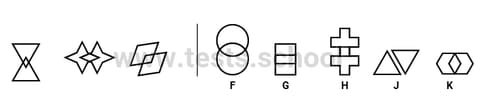
Answer: K.
Option K preserves the relationship between the two outer elements and the central rhombus. The relationship between the components is more important than their individual orientation.
For more complex classifications, compare the outer shapes, central shape, and way the parts interact.
Level G Figure Classification
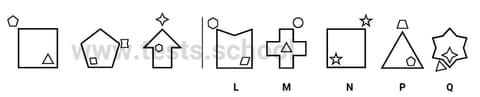
Answer: L.
The figures follow a side-count rule. The inner shape has four sides, the middle shape has five, and the outer shape has six. Option L continues this nested progression.
Count each layer independently before comparing the answer choices.
Figure Matrices Sample Questions
Figure Matrices is the second subtest in the Non-Verbal Reasoning battery.
The student identifies how one figure changes into another and applies the same transformation to a new figure.
Possible changes include:
- rotation;
- reflection;
- movement;
- a change in shading;
- the addition or removal of a component;
- a change in the number or position of elements.
Level A Figure Matrices
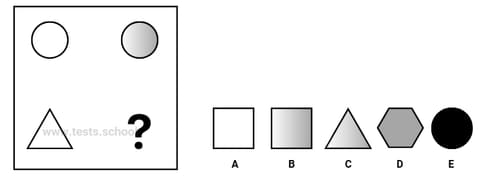
Answer: C.
The first pair shows that the figure becomes filled with a gradient. Applying the same change to the second pair produces option C.
Identify what changes and what remains unchanged before selecting an answer.
Level B Figure Matrices
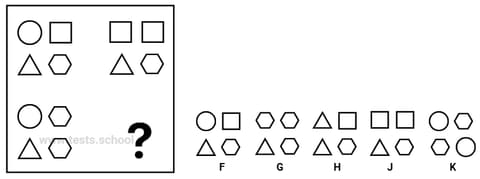
Answer: G.
The transformation shown in the first pair must be repeated in the second pair. Option G applies the same shape-change rule.
Avoid choosing an option simply because it resembles one figure. It must reproduce the complete transformation.
Level C Figure Matrices
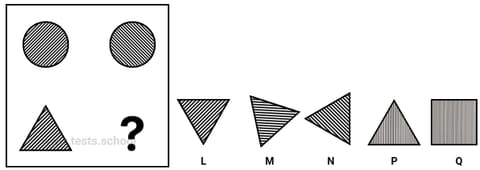
Answer: N.
The diagonal line changes from slanting in one direction to slanting in the opposite direction. Applying the same reversal to the triangle gives option N.
Check direction carefully. A reflected line and a rotated line may look similar but follow different rules.
Level D Figure Matrices
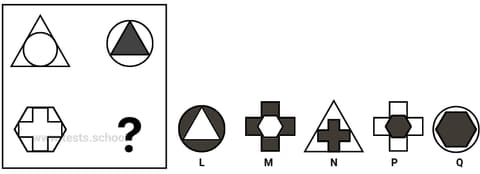
Answer: P.
The first pair changes both the position and the shading of the inner shape. Option P applies both changes to the second pair.
When two features change together, an option that reproduces only one of them is incomplete.
Level E Figure Matrices
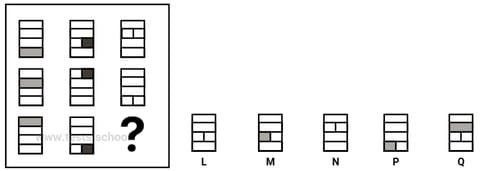
Answer: L.
The shaded section moves according to the same positional rule across the matrix. Option L places the shading in the correct next position.
Track the shaded area separately from the outline of the figure.
Level F Figure Matrices
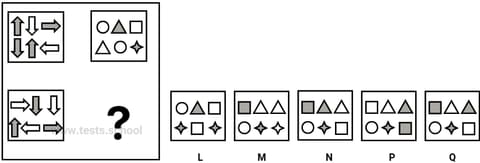
Answer: Q.
The direction of the arrow determines the required shape, while the arrow’s colour determines how that shape is shaded. Option Q satisfies both rules.
This question contains two simultaneous codes. Identify each code independently before combining them.
Level G Figure Matrices
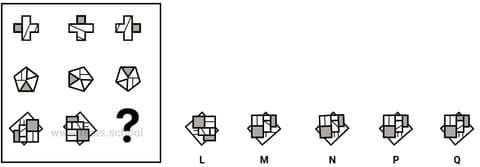
Answer: P.
The shapes rotate clockwise through the matrix. Option P shows the correct orientation after the next rotation.
Use a fixed reference point, such as a corner or protruding line, to track the rotation accurately.
Verbal Classification Sample Questions
Verbal Classification is part of the Verbal Reasoning battery.
The student sees three words with a shared conceptual relationship and chooses another word that belongs to the same group.
Level A Verbal Classification
Purple - Yellow - Orange
A. Paint
B. Colour
C. Red
D. Table
E. Shade
Answer: C - Red.
Purple, yellow, orange, and red are all colours.
The category must include each of the original words. “Colour” names the category but is not another member of the group.
Level B Verbal Classification
Eagle - Hawk - Falcon
A. Vulture
B. Parrot
C. Nest
D. Sparrow
E. Predator
Answer: A - Vulture.
Eagles, hawks, falcons, and vultures are all birds of prey.
“Predator” describes them, but it is a broader category that also includes many animals that are not birds.
Level C Verbal Classification
Violin - Guitar - Cello
A. Musician
B. Harp
C. Strings
D. Piano
E. Xylophone
Answer: B - Harp.
A violin, guitar, cello, and harp are all stringed instruments.
“Strings” names part of the instruments rather than another instrument in the same group.
Level D Verbal Classification
Whisper - Murmur - Mumble
A. Yell
B. Speak
C. Shout
D. Hum
E. Mutter
Answer: E - Mutter.
Whisper, murmur, mumble, and mutter can all describe speaking quietly or indistinctly.
“Speak” is too general, while “yell” and “shout” describe a much louder action.
Level E Verbal Classification
Fragile - Delicate - Brittle
A. Sturdy
B. Strong
C. Flexible
D. Breakable
E. Heavy
Answer: D - Breakable.
Fragile, delicate, brittle, and breakable can all describe something that is easily damaged.
The other words either suggest strength or describe a different physical property.
Level F Verbal Classification
Cryptic - Obscure - Enigmatic
A. Transparent
B. Inscrutable
C. Familiar
D. Straightforward
E. Literal
Answer: B - Inscrutable.
Cryptic, obscure, enigmatic, and inscrutable all describe something that is difficult to understand or interpret.
The remaining options suggest clarity or familiarity.
Level G Verbal Classification
Audacious - Bold - Intrepid
A. Timid
B. Careless
C. Daring
D. Quiet
E. Patient
Answer: C - Daring.
Audacious, bold, intrepid, and daring all describe courage or a willingness to take risks.
“Careless” may involve taking risks, but it does not necessarily involve courage.
Verbal Analogies Sample Questions
Verbal Analogies is the second subtest in the Verbal Reasoning battery.
The student identifies the relationship between the first pair of words and applies the same relationship to the second pair.
A useful method is to complete this sentence:
The first word is related to the second because…
The same sentence should work for the second pair.
Level A Verbal Analogy
Tree is to forest as star is to…
A. Night
B. Sky
C. Galaxy
D. Light
E. Moon
Answer: C - Galaxy.
A tree is one member of a forest. In the same way, a star is one member of a galaxy.
The relationship is individual item to larger group.
Level B Verbal Analogy
Dog is to bark as cat is to…
A. Meow
B. Scratch
C. Fur
D. Tail
E. Brush
Answer: A - Meow.
A dog makes a barking sound. A cat makes a meowing sound.
The relationship is animal to characteristic sound.
Level C Verbal Analogy
Pen is to write as brush is to…
A. Paint
B. Clean
C. Draw
D. Colour
E. Crayon
Answer: A - Paint.
A pen is a tool used to write. A brush is a tool used to paint.
The relationship is tool to primary action.
Level D Verbal Analogy
Bird is to nest as bee is to…
A. Hive
B. Flower
C. Buzz
D. Honey
E. Comb
Answer: A - Hive.
A bird lives in a nest. A bee lives in a hive.
The relationship is animal to home.
Level E Verbal Analogy
Compass is to direction as clock is to…
A. Time
B. Hands
C. Numbers
D. Alarm
E. Measurement
Answer: A - Time.
A compass indicates direction. A clock indicates time.
The relationship is instrument to information provided.
Level F Verbal Analogy
Architect is to blueprint as composer is to…
A. Conductor
B. Orchestra
C. Opera house
D. Symphony
E. Instrument
Answer: D - Symphony.
An architect creates a blueprint. A composer creates a symphony.
The relationship is professional to work created.
Level G Verbal Analogy
Lawyer is to contract as scientist is to…
A. Laboratory
B. Research paper
C. Microscope
D. Experiment
E. Evidence
Answer: B - Research paper.
A lawyer may draft a contract as a professional document. A scientist may write a research paper as a professional document.
The relationship is professional to document produced.
Number Analogies Sample Questions
Number Analogies is part of the Quantitative Reasoning battery.
The student identifies the rule connecting each number pair and applies it to the final pair.
The same operation must work for all the completed pairs.
Level A Number Analogy
20 → 4 40 → 8 60 → ?
A. 10
B. 12
C. 16
D. 15
E. 18
Answer: B - 12.
Each number is divided by 5:
- 20 ÷ 5 = 4
- 40 ÷ 5 = 8
- 60 ÷ 5 = 12
For similar questions, test a simple operation before looking for a more complicated rule.
Level B Number Analogy
7 → 49 8 → 64 9 → ?
A. 72
B. 81
C. 85
D. 90
E. 99
Answer: B - 81.
Each number is multiplied by itself:
- 7 × 7 = 49
- 8 × 8 = 64
- 9 × 9 = 81
The rule is to square the starting number.
Level C Number Analogy
30 → 15 50 → 25 70 → ?
A. 35
B. 40
C. 45
D. 50
E. 55
Answer: A - 35.
Each starting number is divided by 2:
- 30 ÷ 2 = 15
- 50 ÷ 2 = 25
- 70 ÷ 2 = 35
Level D Number Analogy
4 → 24 6 → 48 8 → ?
A. 56
B. 64
C. 72
D. 80
E. 96
Answer: D - 80.
Each number is multiplied by the next even number:
- 4 × 6 = 24
- 6 × 8 = 48
- 8 × 10 = 80
Check that the relationship changes consistently with each pair.
Level E Number Analogy
2 → 8 3 → 27 4 → ?
A. 32
B. 64
C. 81
D. 100
E. 125
Answer: B - 64.
Each number is cubed:
- 2 × 2 × 2 = 8
- 3 × 3 × 3 = 27
- 4 × 4 × 4 = 64
Level F Number Analogy
12 → 18 20 → 30 28 → ?
A. 36
B. 40
C. 42
D. 44
E. 48
Answer: C - 42.
Each number increases by half of its original value:
- half of 12 is 6, so 12 + 6 = 18;
- half of 20 is 10, so 20 + 10 = 30;
- half of 28 is 14, so 28 + 14 = 42.
This is equivalent to multiplying each number by 1.5.
Level G Number Analogy
4 → 10 6 → 16 8 → ?
A. 22
B. 24
C. 26
D. 28
E. 32
Answer: A - 22.
Multiply the starting number by 3, then subtract 2:
- 4 × 3 − 2 = 10
- 6 × 3 − 2 = 16
- 8 × 3 − 2 = 22
When a single operation does not work, test a consistent two-step rule.
Number Series Sample Questions
Number Series is the second subtest in the Quantitative Reasoning battery.
The student identifies the rule governing a sequence and selects the next number.
Useful checks include:
- differences between consecutive terms;
- multiplication or division;
- alternating operations;
- increasing or decreasing differences;
- separate interwoven sequences.
Level A Number Series
50, 45, 40, 35, ?
A. 25
B. 30
C. 20
D. 28
E. 15
Answer: B - 30.
The sequence decreases by 5 each time:
50, 45, 40, 35, 30
Level B Number Series
81, 72, 63, 54, ?
A. 36
B. 46
C. 48
D. 45
E. 42
Answer: D - 45.
The sequence decreases by 9 each time:
81, 72, 63, 54, 45
Level C Number Series
2, 4, 8, 16, ?
A. 20
B. 24
C. 36
D. 32
E. 38
Answer: D - 32.
Each number is multiplied by 2:
2, 4, 8, 16, 32
Level D Number Series
3, 9, 27, 81, ?
A. 162
B. 243
C. 324
D. 180
E. 270
Answer: B - 243.
Each number is multiplied by 3:
3, 9, 27, 81, 243
Level E Number Series
1, 0, 8, 7, 15, 14, 22, ?
A. 18
B. 19
C. 21
D. 30
E. 31
Answer: C - 21.
The operations alternate:
- subtract 1;
- add 8.
This gives:
1, 0, 8, 7, 15, 14, 22, 21
Write the operations beneath the sequence when the pattern alternates.
Level F Number Series
1, 3, 7, 15, 31, 63, 127, ?
A. 255
B. 168
C. 284
D. 227
E. 155
Answer: A - 255.
Each number is doubled and then increased by 1:
- 1 × 2 + 1 = 3
- 3 × 2 + 1 = 7
- 7 × 2 + 1 = 15
- 127 × 2 + 1 = 255
Level G Number Series
4, 22, 9, 8, 44, 18, 16, 88, 36, ?
A. 86
B. 176
C. 32
D. 54
E. 72
Answer: C - 32.
The sequence contains three interwoven series:
- first, fourth, seventh, and tenth terms: 4, 8, 16, 32;
- second, fifth, and eighth terms: 22, 44, 88;
- third, sixth, and ninth terms: 9, 18, 36.
Each separate series doubles.
When one rule does not connect every neighbouring term, compare every second or third term.
Figure Analysis Sample Questions
Figure Analysis is part of the Spatial Ability battery.
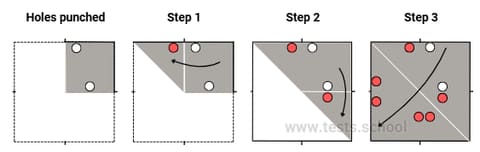
The student sees a square of paper being folded and then punched. They must determine where the holes or marks will appear when the paper is completely unfolded.
A useful method is to reverse the folds one at a time:
- begin with the final folded shape;
- undo the most recent fold;
- reflect every existing mark across that fold line;
- undo the previous fold;
- repeat until the paper is fully open.
The distance between a mark and the fold line must remain the same after reflection.
Level A Figure Analysis
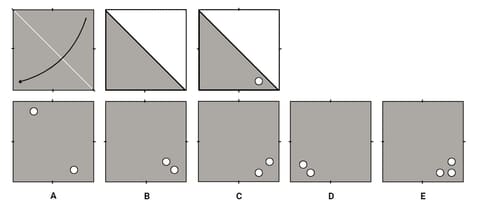
Answer: C.
Undoing the fold reflects the punched hole across the fold line. The unfolded paper therefore contains two holes in matching positions.
For similar questions, identify the fold line and mirror the mark across it.
Level B Figure Analysis
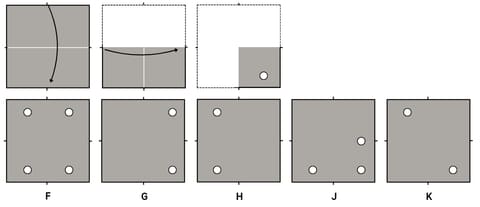
Answer: F.
The paper has been folded across two axes. Reversing both folds creates four matching holes, one in each corresponding section of the square.
Undo the last fold first rather than attempting to imagine the final answer immediately.
Level C Figure Analysis
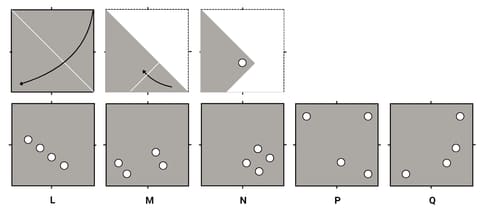
Answer: N.
Two folds create symmetry across two fold lines. The punched hole is reflected once when the first fold is reversed and again when the second fold is reversed, producing four positions.
Each reflected hole must remain the same distance from its fold line as the original.
Level D Figure Analysis
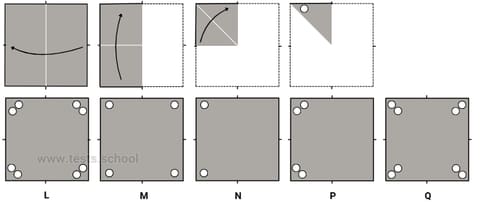
Answer: L.
Option L places the marks in the mirrored positions created by reversing the final fold and then the earlier fold. The number and spacing of the marks are both consistent with the fold sequence.
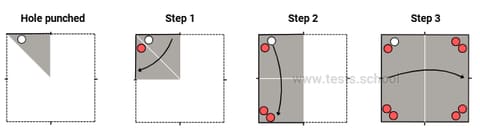
Level E Figure Analysis
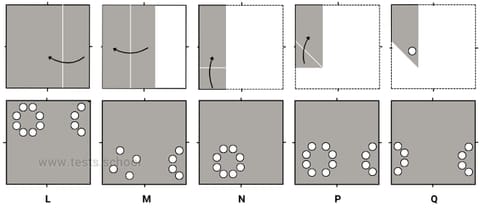
Answer: P.
Option P reproduces each punched position across the relevant fold lines while preserving its distance from those lines. The distractors either omit a reflected mark or place one on the wrong side.
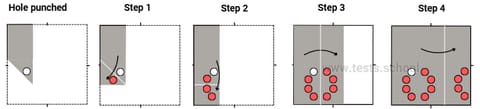
Level F Figure Analysis
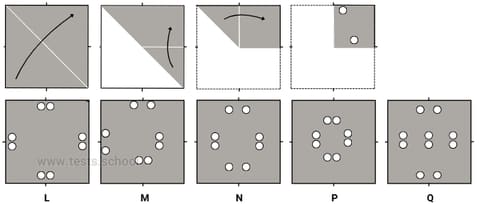
Answer: M.
Option M has the correct number of marks and preserves their orientation and mirrored spacing after every fold is reversed.
Check the answer after each individual unfolding. A single incorrect reflection changes the final arrangement.
Level G Figure Analysis
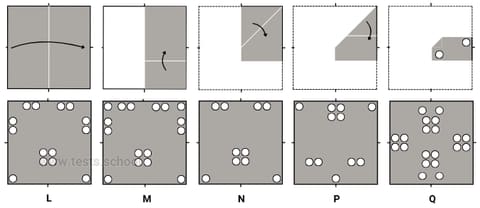
Answer: L.
Option L preserves the full pattern of reflection produced by the sequence of folds. Both the number of marks and their positions relative to the fold lines are correct.
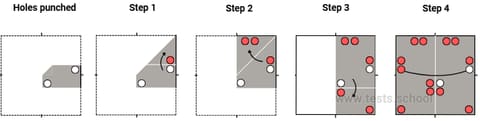
Figure Recognition Sample Questions
Figure Recognition is the second subtest in the Spatial Ability battery.
The student must find a target shape hidden within a more complex design.
The target may be:
- rotated;
- placed at an unfamiliar angle;
- crossed by additional lines;
- embedded within a larger figure.
The target must retain the same line lengths, angles, and relative proportions. It may be rotated, but it must not be stretched, reflected, or altered unless the instructions explicitly permit that change.
Level A Figure Recognition
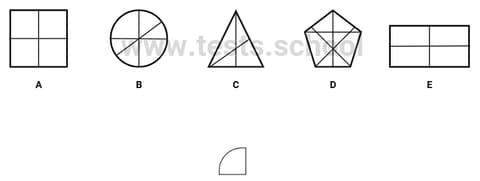
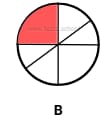
Answer: B.
The target shape appears within option B after rotation. Its line segments and angles remain in the same relative positions.
The additional lines are distractors and do not form part of the target.
Level B Figure Recognition
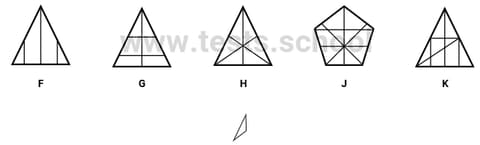
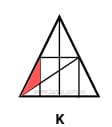
Answer: K.
Option K contains the complete target outline. The target is surrounded and crossed by other lines, but its original angles and connections remain visible.
Level C Figure Recognition
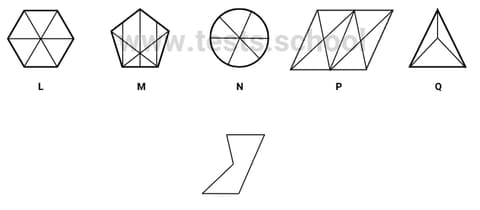
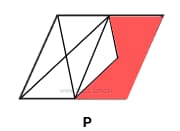
Answer: P.
The traced section in option P reproduces the target’s line sequence and angles. Its orientation has changed, but its proportions have not.
Level D Figure Recognition
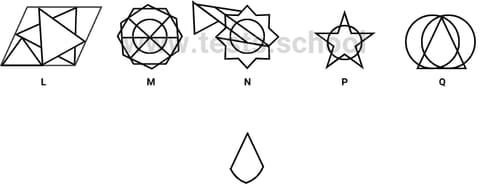
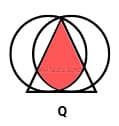
Answer: Q.
Option Q contains every segment of the target in the correct order. The surrounding lines create a larger design but do not change the target itself.
Level E Figure Recognition
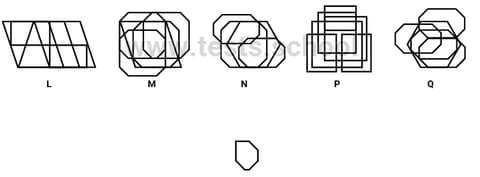
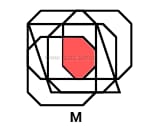
Answer: M.
The relevant lines in option M match the target’s distinctive angles and relative segment lengths. The shape is easier to identify when the outside orientation is ignored.
Level F Figure Recognition
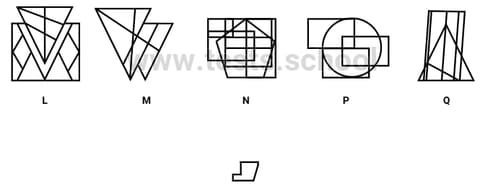
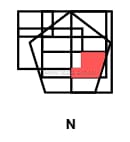
Answer: N.
Option N contains the target as a continuous set of connected lines. The crossing lines act only as distractions.
Follow the target from one endpoint to the other instead of trying to recognise the whole outline at once.
Level G Figure Recognition
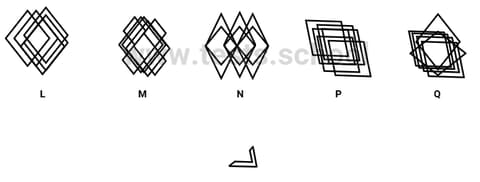
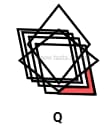
Answer: Q.
The traced lines in option Q preserve the target’s complete structure, including its angles, connections, and relative segment lengths.
The target is rotated and embedded within a denser design, but it has not been reflected or distorted.
How Can Your Child Approach CAT4 Questions?
CAT4 questions become easier to understand when students use a consistent method.
Verbal questions
Encourage your child to:
- define the relationship in their own words;
- check that the same definition applies to every word;
- distinguish a category name from a member of the category;
- reject options that are only loosely associated.
Number questions
Encourage your child to:
- test addition and subtraction first;
- compare the differences between terms;
- test multiplication and division;
- look for alternating operations;
- check for two interwoven sequences;
- apply the rule to every completed example.
Figure questions
Encourage your child to compare:
- shape;
- number of sides;
- shading;
- position;
- direction;
- rotation;
- reflection;
- movement;
- the number of separate elements.
Spatial questions
For paper-folding questions, reverse one fold at a time.
For hidden-shape questions, identify a distinctive angle or line first and trace the shape from that point.
Parent note:
If your child chooses an incorrect answer, focus on the missed clue rather than the result. Ask which feature they noticed first and which additional feature would have helped them eliminate the distractor.
Should Your Child Complete Timed Practice?
When the school permits practice, families can review TestPrep-Online CAT4 preparation packs or compare options with CAT4 practice test overview. Confirm the grade or level, current pack contents, access terms, and school policy before purchasing.
Official CAT4 Levels A to G contain strictly timed subtests. However, the examples on this page are intended primarily to explain the formats.
When your child first encounters a question type, allow enough time to understand the instructions and reasoning process. Introducing a strict time limit too early may create pressure without improving understanding.
When the format is familiar and the school permits preparation, a short timed activity may help your child practise:
- moving on from a difficult question;
- maintaining a steady pace;
- checking simple calculations efficiently;
- making a reasonable choice when unsure.
Do not use an unofficial score from this page to predict an official CAT4 result. These questions are not standardised and cannot produce a Standard Age Score, percentile, or stanine.
When Might a Complete CAT4 Practice Pack Be Useful?
A complete preparation resource may be considered when:
- the school permits CAT4 familiarisation;
- the school has confirmed the correct level;
- your child needs more examples of an unfamiliar question type;
- you want exercises organised by battery;
- your child benefits from detailed explanations;
- you need a more structured preparation schedule.
Before purchasing a pack, confirm:
- the exact CAT4 level;
- the question types included;
- whether the content matches the correct age group;
- the current access period;
- the provider’s current terms;
- whether your child’s school recommends preparation.
Explore CAT4 practice by level:
Families who decide that structured familiarisation is appropriate can review the current TestPrep-Online CAT4 preparation packs. Check the current pack contents and confirm the level before purchasing.
Practice cannot guarantee a particular CAT4 score, school admission, placement, subject setting, or educational outcome.
Frequently Asked Questions
Are these official CAT4 questions?
No. Every question on this page was independently created. The questions are not taken from the official assessment and are not published, approved, or endorsed by GL Assessment.
Which question types appear in CAT4 Levels A to G?
Levels A to G generally include:
- Figure Classification;
- Figure Matrices;
- Verbal Classification;
- Verbal Analogies;
- Number Analogies;
- Number Series;
- Figure Analysis;
- Figure Recognition.
These eight subtests form four reasoning batteries.
Which CAT4 level should my child practise?
Use the level stated by the school or testing provider. CAT4 levels have overlapping age ranges, and the school may select a level according to the assessment date or testing purpose.
Are these questions the same difficulty as the official CAT4?
No. The questions demonstrate relevant skills and broad formats, but they do not reproduce the official difficulty or standardisation of any CAT4 level.
Can I calculate a CAT4 score from these questions?
No. An official CAT4 score is produced from a standardised assessment and interpreted using age-based norms. A result from an independent question set cannot be converted into a valid Standard Age Score, percentile rank, or stanine.
Is CAT4 adaptive?
CAT4 uses level-specific, strictly timed subtests. It should not be confused with adaptive assessments that select each new question according to the student’s previous answer.
Should my child revise for CAT4?
GL Assessment advises against specific CAT4 training because extensive preparation may affect the reliability of the results. Ask your school what degree of familiarisation, if any, it considers appropriate.
Can familiarisation reduce test anxiety?
Seeing an unfamiliar task format in advance may help some children understand what the instructions require. Familiarisation should remain calm, proportionate, and appropriate for the child’s age.
What should I do when my child answers incorrectly?
Ask your child to explain how they reached the answer. Then identify the missed relationship, visual feature, or calculation. The explanation is more useful than simply revealing the correct option.
Where can I learn how CAT4 scores work?
Read our complete CAT4 guide for an explanation of Standard Age Scores, percentiles, stanines, battery profiles, levels, and official timings.
CAT4 guides and practice
Read the CAT4 practice hub, CAT4 scores and levels and CAT4 sample questions. Compare Canadian CCAT, gifted test comparison and MAP Growth if you are evaluating multiple assessments. Optional practice: TestPrep-Online CAT4 preparation packs, CAT4 practice test overview and TestPrep-Online Family Membership.
Related School Assessment Guides
- Read the complete CAT4 test guide
- Learn about NWEA MAP Growth
- Explore Renaissance Star Assessments
- Understand the i-Ready assessment
- Read about the Canadian Cognitive Abilities Test
Tests.School is an independent educational website. It is not affiliated with, endorsed by, or part of GL Assessment. Always follow the current instructions supplied by your child’s school and the official assessment publisher.